
When someone fails to act with reasonable care, and that failure causes harm, the law allows the injured person to seek compensation. This concept, known as negligence, is the foundation of most personal injury claims in Pennsylvania.
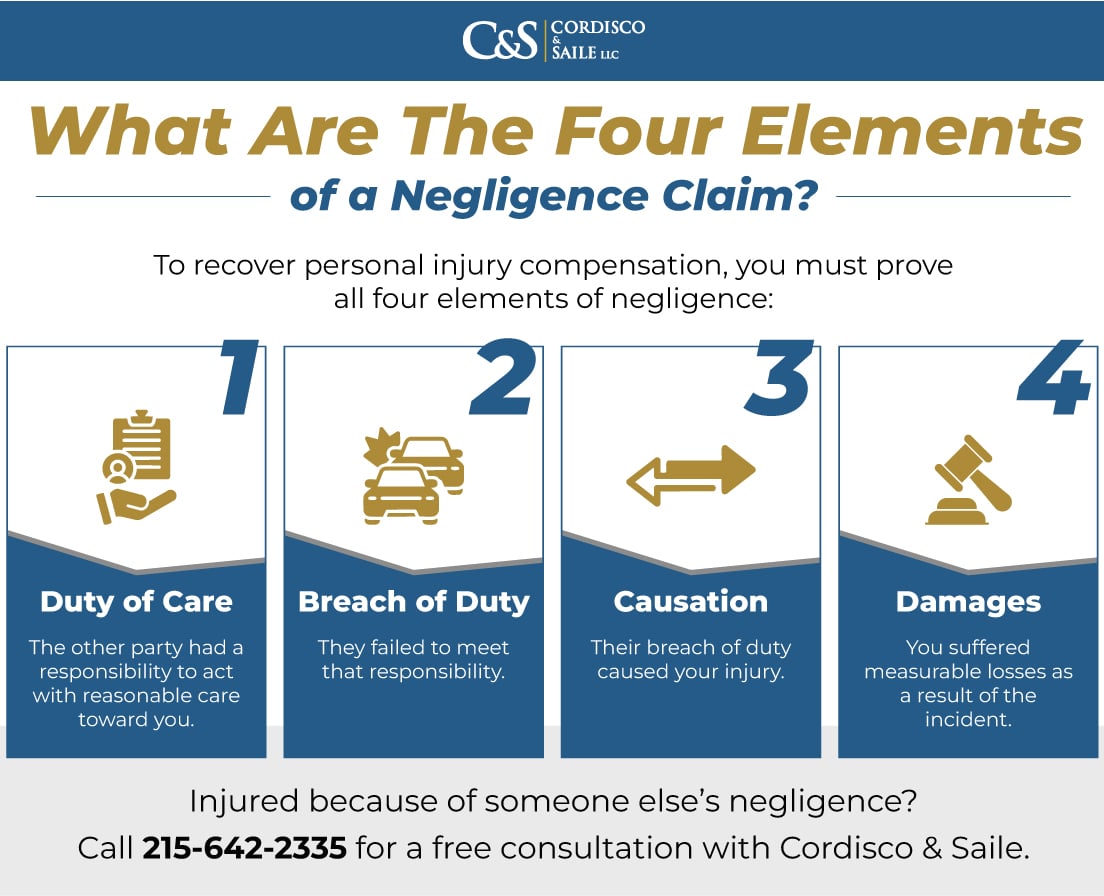
To recover compensation, you must prove the four elements of negligence: duty of care, breach of duty, causation, and damages. If you or a loved one has suffered harm due to someone else’s negligence, Cordisco & Saile can help you build a strong personal injury claim with solid evidence proving each of those essential elements.
The Four Elements of Negligence
After an accident, it may seem obvious that someone else was at fault. However, courts and insurance companies will only award compensation if you can prove that the other party was negligent. That means establishing four specific elements that connect the person’s reckless conduct to your injury and resulting losses.
Duty of Care
To recover compensation, you must establish that the at-fault party owed you a duty of care. This refers to the legal responsibility to act with reasonable care and caution to prevent causing harm to others.
A duty of care automatically exists in certain contexts. Drivers owe a duty to others on the road to follow traffic laws and operate their vehicles safely, while property owners owe a duty to keep their premises reasonably safe for lawful visitors. Health care providers owe patients a duty to provide treatment that meets accepted medical standards.
Breach of Duty
After establishing that a duty of care existed, the next step is to show that the person failed to meet that responsibility. A breach of duty happens when someone’s actions or inaction fall below the level of care the law requires in that specific situation.
This means the at-fault party did something a reasonably careful person would not have done. It could also mean they failed to do something a reasonably careful person would have done. This could involve a driver speeding through a red light, a store owner failing to mark a wet floor after discovering the hazard, or a medical provider discharging a patient without treating their obvious signs of infection.
Causation
Next, you must prove that the at-fault party’s breach of duty caused your injury. Causation has two parts:
- Actual cause: This requires proof that the injury would not have happened without the other person’s actions. For example, if a driver runs a red light and crashes into your vehicle, your injuries would not have occurred if not for that traffic violation.
- Proximate cause: The injury must be a direct and predictable result of the careless act. For example, if a driver runs a red light and causes a crash, injuries are a foreseeable outcome. That driver can be held responsible for those injuries, but they would not be liable for something unrelated that happens later.
Damages
This final element requires you to prove that you suffered actual losses as a result of your injury. These may include economic damages such as medical expenses, lost income, and property damage. They may also include non-economic damages, such as physical pain, emotional distress, or loss of enjoyment of life.
Proving Negligence in a Personal Injury Case
A strong personal injury case has thorough evidence supporting each element of negligence, such as:
- Accident Reports: Official reports can provide an objective record of the incident that caused your injury.
- Medical Records: Records of your diagnosis and treatment can establish a direct link between the incident and your injuries, while also documenting some of your damages.
- Photos and Videos: Visual evidence, such as photos of the accident scene and surveillance footage, can show how the incident occurred.
- Witness Testimony: Statements from people who saw the incident can support your version of what happened.
- Expert Opinions: Third-party medical professionals, accident reconstruction specialists, or economic experts can explain how the conduct fell below accepted safety standards and how it led to your injuries.
You may still have a valid claim even if the evidence shows that your own negligence contributed to your injuries. Pennsylvania’s comparative negligence law allows you to recover compensation if you’re less than 51% at fault for the incident, but your award may be reduced proportionally.
Types of Negligence in Pennsylvania Personal Injury Cases
While every personal injury claim must prove the same four components of negligence, the nature of the negligent conduct can vary. This leads to different levels of negligence:
- Ordinary Negligence: This occurs when someone fails to use the level of care that a reasonable person would use in a similar situation. For example, a store employee who forgets to clean up a spill in a grocery aisle may be ordinarily negligent if a customer slips and falls.
- Gross Negligence: This involves more extreme carelessness that reflects a serious disregard for others’ safety. For instance, getting behind the wheel after having multiple drinks may be classified as gross negligence.
- Negligence Per Se: This type occurs when someone violates a law designed to protect public safety. A trucking company ignoring federal safety regulations requiring driver rest periods may give rise to a negligence per se claim.
How Does the Level of Negligence Affect Your Compensation?
In most cases, an injured person may recover compensation for economic and non-economic damages, such as medical expenses, lost income, and pain and suffering. The goal of these damages is to compensate the injured person for the losses they suffered as a result of the accident.
When conduct rises to the level of gross negligence, it may support a claim for punitive damages. These are intended to punish the defendant for especially reckless behavior and discourage similar conduct in the future. They’re awarded only in limited circumstances involving the most extreme cases of negligence or intentional harm.
Having the right attorney on your side can make all the difference in your financial recovery. When you choose us to represent you, our team will pursue every dollar you’re entitled to based on the extent of the negligence that caused you harm. This includes evaluating your circumstances and determining if your case meets the criteria to seek punitive damages, which may significantly increase your award.
We’re Ready To Help You Prove the Other Party’s Negligence
Understanding the four elements of negligence is an important first step toward a successful injury claim. However, applying those elements to real-world facts requires careful analysis and extensive documentation. Cordisco & Saile is here to help you build a well-developed case for the other party’s negligence and fight for the compensation you deserve.
You only get one shot to bring your claim, so get it right the first time by having our award-winning team of personal injury lawyers on your side. We’ve recovered over $100 million for people affected by someone else’s negligence, and we’re ready to put that track record to work for you. Contact us online or call 215-642-2335 for a free consultation about your rights, options, and next steps.